
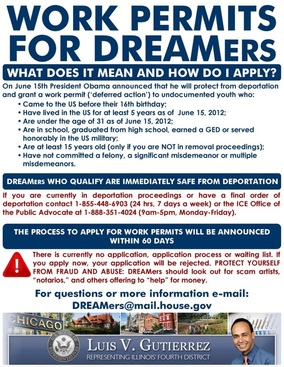
It has been a busy week. Our firm has received dozens of calls and emails about the new deferred action policy. Here is the first round of frequently asked question (FAQ):
1. Is this the DREAM Act?
No, it is NOT the DREAM Act. Do not call it the DREAM Act, because if you do, you will confuse yourself. This is not an act, not a law. It is just a change in policy. That means it's something the government has decided it will do. They are agreeing not to deport people who meet certain qualifications. And allow them to file for a work permit good for two years and renewable.
2. I'm over 30 now. Do I qualify?
No, not under this policy. However, you should still talk to a lawyer. Depending on your situation, the government still might be willing to grant you deferred action. But only an experienced lawyer can say whether this is a good idea. If you try to do it yourself, you are playing with fire.
3. I didn't finish high school. Do I qualify?
See answer above. However - this is a great time to go get your GED. If you have a GED you can make yourself qualified. There is no deadline for filing (like there is for TPS) so as soon as you are qualified, you can file.
4. Can I file anything now?
No. Wait for the regulations to come out. We expect them in mid-August. We hope it will be sooner.
5. I walked across the border. How do I prove when I came in?
This is why you should not file without a lawyer. You only get one shot. If you are denied, you will wind up getting put into removal (deportation) proceedings. But proving entry means showing the earliest possible proof of your presence in the US. Your lawyer can explain how to do this.
6. I have a misdemeanor on my record, how can I tell whether this will be a "serious misdemeanor"? Will I qualify?
We do not know yet. Make sure you get the conviction records. Once the regulations come out, you should talk to a lawyer to see whether it will affect you or not.
7. I came here for the first time when I was under 16, but I left and came back. Do I qualify?
You have to have been in the US between 6/15/2007 and 6/15/2012. If you were out of the country during these dates, you might not qualify. However, we will not know for sure until the regulations come out. It may be that we can argue that a short trip does not break the continuity of presence.
8. What if I file and I don't qualify? What will happen?
The June 15 memorandum makes clear that the existing guidelines for NTA issuance are consistent with the new policy. This means that if you file and you don't qualify, you can (and probably will) be put into removal proceedings. So be careful and do not be impatient.
9. If I qualify, and I get deferred action, can the government change its mind and decide later to deport me?
Yes. It can. We hope that will not happen, of course, but it is a possibility.
10. Should I get a lawyer to help me file?
Yes. This is not the type of thing you want to do by yourself. The main reason is, you want to be sure it's right. Because if it is not, you will get put into removal proceedings. A good lawyer will help you think of additional evidence to strengthen your case. A good lawyer will be there to help you if the government asks for more evidence while your case is pending. And if it's denied, a good lawyer can help you explore other options.
1. Is this the DREAM Act?
No, it is NOT the DREAM Act. Do not call it the DREAM Act, because if you do, you will confuse yourself. This is not an act, not a law. It is just a change in policy. That means it's something the government has decided it will do. They are agreeing not to deport people who meet certain qualifications. And allow them to file for a work permit good for two years and renewable.
2. I'm over 30 now. Do I qualify?
No, not under this policy. However, you should still talk to a lawyer. Depending on your situation, the government still might be willing to grant you deferred action. But only an experienced lawyer can say whether this is a good idea. If you try to do it yourself, you are playing with fire.
3. I didn't finish high school. Do I qualify?
See answer above. However - this is a great time to go get your GED. If you have a GED you can make yourself qualified. There is no deadline for filing (like there is for TPS) so as soon as you are qualified, you can file.
4. Can I file anything now?
No. Wait for the regulations to come out. We expect them in mid-August. We hope it will be sooner.
5. I walked across the border. How do I prove when I came in?
This is why you should not file without a lawyer. You only get one shot. If you are denied, you will wind up getting put into removal (deportation) proceedings. But proving entry means showing the earliest possible proof of your presence in the US. Your lawyer can explain how to do this.
6. I have a misdemeanor on my record, how can I tell whether this will be a "serious misdemeanor"? Will I qualify?
We do not know yet. Make sure you get the conviction records. Once the regulations come out, you should talk to a lawyer to see whether it will affect you or not.
7. I came here for the first time when I was under 16, but I left and came back. Do I qualify?
You have to have been in the US between 6/15/2007 and 6/15/2012. If you were out of the country during these dates, you might not qualify. However, we will not know for sure until the regulations come out. It may be that we can argue that a short trip does not break the continuity of presence.
8. What if I file and I don't qualify? What will happen?
The June 15 memorandum makes clear that the existing guidelines for NTA issuance are consistent with the new policy. This means that if you file and you don't qualify, you can (and probably will) be put into removal proceedings. So be careful and do not be impatient.
9. If I qualify, and I get deferred action, can the government change its mind and decide later to deport me?
Yes. It can. We hope that will not happen, of course, but it is a possibility.
10. Should I get a lawyer to help me file?
Yes. This is not the type of thing you want to do by yourself. The main reason is, you want to be sure it's right. Because if it is not, you will get put into removal proceedings. A good lawyer will help you think of additional evidence to strengthen your case. A good lawyer will be there to help you if the government asks for more evidence while your case is pending. And if it's denied, a good lawyer can help you explore other options.
 RSS Feed